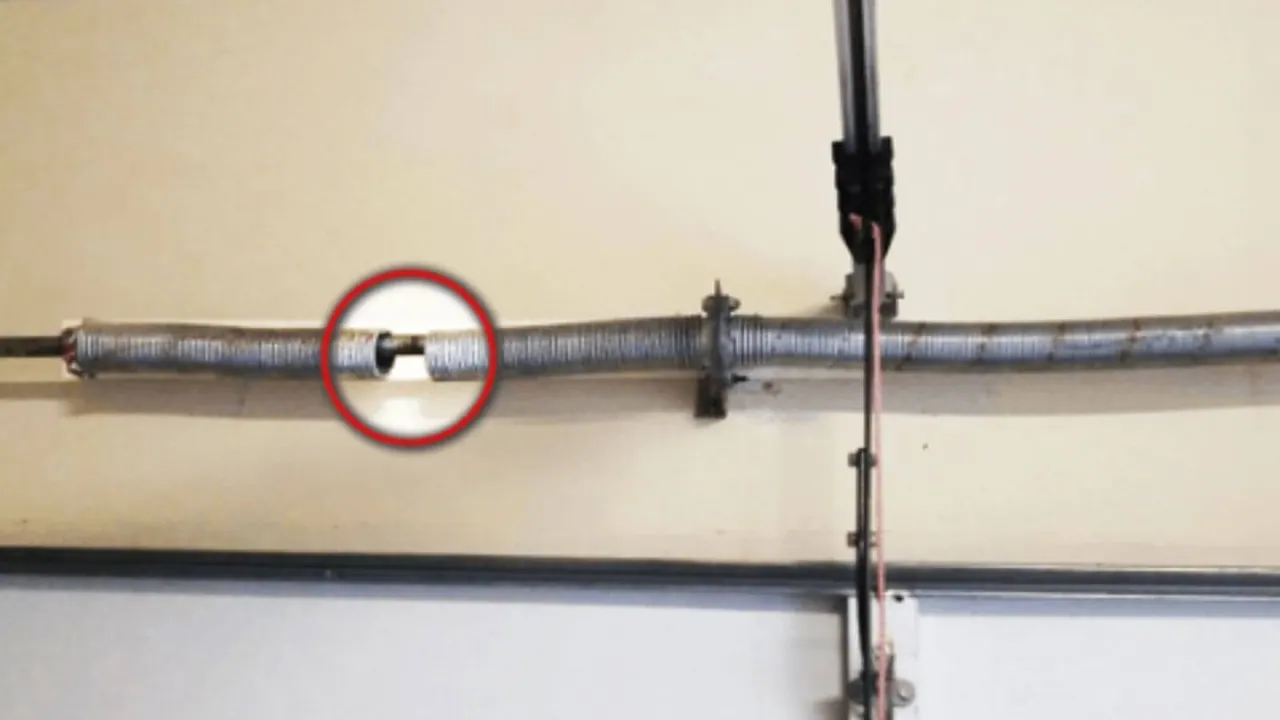
A broken spring usually shows as a visible gap in the coil above the door, a loud bang from the garage, and a door that feels extremely heavy or only lifts a few inches. Stop using the opener, keep the door closed if you can, and text a pro a photo of the spring.
Springs do the heavy lifting on your garage door. A typical two-car steel door weighs well over a hundred pounds, and the spring system is what lets a small opener motor, or your own two hands, move it. When a spring breaks, the whole door changes how it behaves. Here are the signs we see most often on service calls around Chandler and the rest of the Valley.
1. A two-inch gap in the spring
Most Phoenix-area homes have a torsion spring mounted on a bar right above the door. Look up at it with the door closed. A healthy spring is one tight coil. A broken one has a clear gap, usually a couple of inches wide, where the coil snapped and unwound. This is the most reliable sign, and it is easy to photograph and text to us.
2. You heard a loud bang
A spring under tension releases a lot of energy when it breaks. Many homeowners think a car backfired or something fell off a shelf. If you heard a bang from the garage and the door has acted strange since, a spring is the first thing to check. We wrote a whole guide on that mystery bang in the garage.
3. The door only opens a few inches
Openers are built to guide the door, not lift its full weight. With a broken spring the opener strains, lifts six inches or so, then stops or reverses. Some openers have a force limit that kicks in and makes the door refuse to move at all.
4. The door feels incredibly heavy
If you pull the emergency release and try the door by hand, a balanced door should lift with modest effort and stay put halfway. With a broken spring it feels like a solid wall of steel. Do not force it. A heavy door can drop quickly and hurt someone.
5. Cables are loose or hanging
When the spring lets go, tension comes off the lift cables on each side of the door. You may see a cable hanging loose, or wrapped off its drum at the top corner. That often looks like a cable problem, but the spring is the root cause.
6. The door is crooked
On doors with two springs, one can break while the other holds. The door then lifts unevenly, one side higher than the other. Keep using it like that and you risk bending the track or pulling the door off its rollers. See our guide to a crooked or uneven garage door.
7. The door slams shut
A door that drops fast in the last few feet, or slams on the floor, has lost its counterbalance. That is a safety problem for kids, pets and cars, not just a noise issue.
What to do right now
- Stop pressing the opener button. Repeated tries can strip the opener’s gear or burn out the motor.
- If the door is closed, leave it closed. If it is open, keep everyone out from under it.
- Do not try to wind or adjust the spring yourself. Torsion springs hold enough force to cause serious injury. Here is why spring work belongs to a pro.
- Take a photo of the spring and the cables and text it to us. We can usually tell you what broke before we arrive.
Why springs break so often here
Springs are rated for a certain number of open and close cycles. Arizona heat does not help: garages here regularly get far hotter than the outside air in summer, lubricant dries out, and rust from monsoon humidity speeds up wear. We cover the details in how long garage door springs last in Arizona.
If you are in Chandler, Ocotillo, Fulton Ranch or anywhere nearby, we offer same day garage door repair in Chandler and give you the exact price before any work starts. Broken springs are one of the most common jobs on our garage door repair list.